

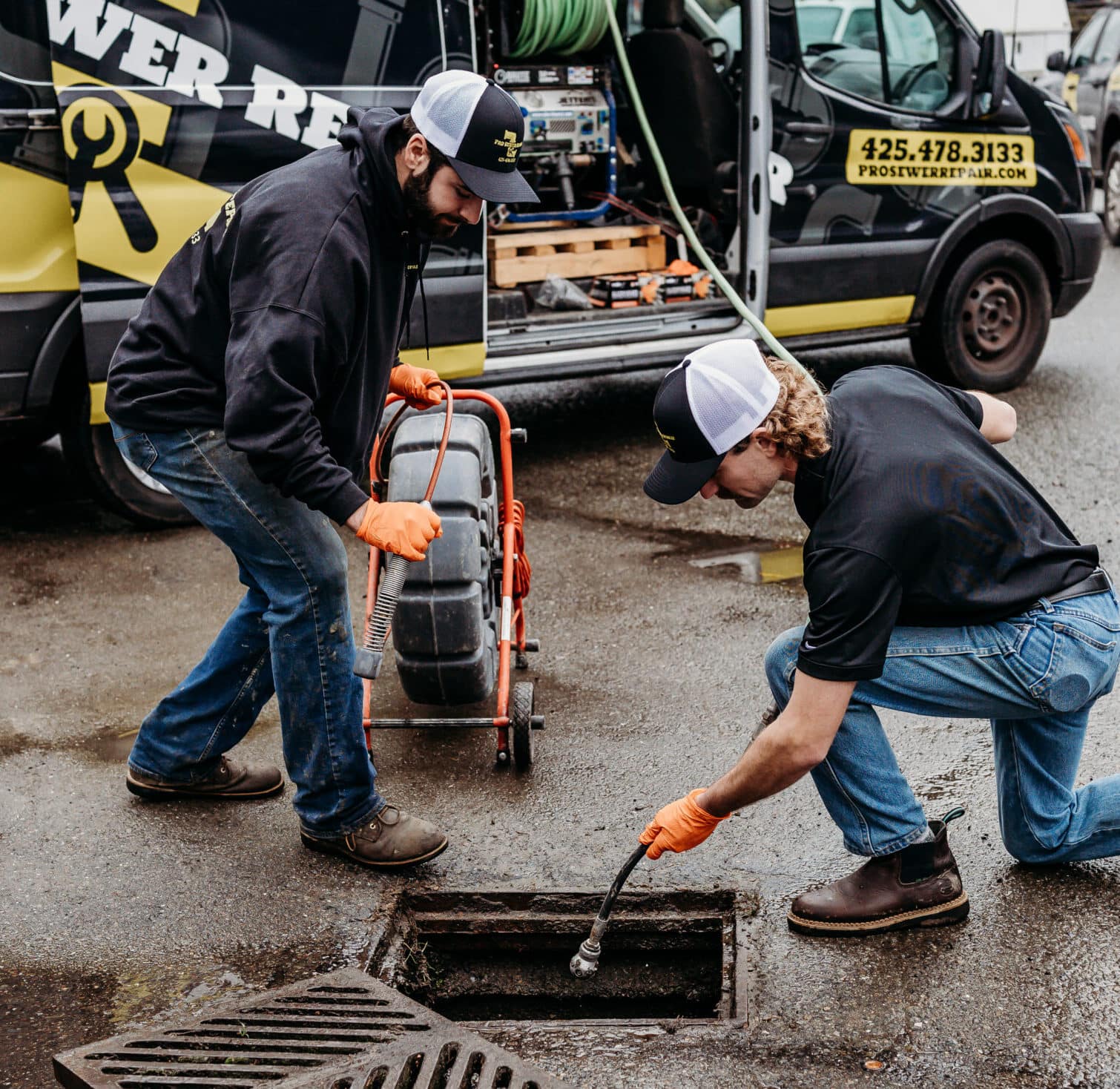
The sewer line running beneath your Bellevue, WA property does its job invisibly, day after day, until it does not. And when it fails, the repair is expensive, disruptive, and almost always something that could have been prevented with a modest amount of attention in the years leading up to it.
Preventative sewer maintenance is not complicated work. It is a handful of daily habits, a few seasonal checkpoints, and periodic professional visits that together keep a pipe functioning for decades longer than one that gets no attention at all.
Most Bellevue homeowners know they are responsible for maintaining the roof, the furnace, and the water heater. Far fewer realize they also own and are responsible for the sewer lateral that carries wastewater from their home to the city main.
Under Bellevue City Code 24.04.115, side sewers on private property are exclusively owned by the property owner, and under section 24.04.210, owners of private sewer systems are solely responsible for their maintenance and operation. That means the cost of neglect falls entirely on you, not the city.
This article covers the practical steps Bellevue homeowners can take at every level, from what you put down the drain today to when you schedule your next professional inspection, to keep your sewer line healthy and avoid the kind of emergency that turns a manageable maintenance item into a five-figure repair.
In this article, you will learn about:
- Why preventative maintenance matters more than most homeowners realize
- Know your pipe before you try to maintain it
- The daily habits that protect your sewer line for free
- Seasonal maintenance that actually makes a difference
- Professional services on a schedule, not after a backup
- How to tell when maintenance alone is no longer enough
Keep reading to build a practical maintenance plan that fits your home, your pipe’s condition, and your budget.
Why preventative maintenance matters more than most homeowners realize
Sewer maintenance gets skipped not because it is difficult, but because the pipe is underground and invisible. The problems it develops are equally invisible until they produce a backup, an odor, or a soggy patch in the yard. By that point, the damage has been building for months or years, and the repair options are narrower and more expensive than they would have been with earlier attention.
Your side sewer is your responsibility, from the house to the main
Bellevue’s wastewater system sends flows through city-owned pipes into King County’s regional system for treatment. The City of Bellevue maintains sewer lines within the public right of way and dedicated easements, including the service connections up to the edge of the right of way. Everything from that point back to your home is yours.
That private side sewer includes the pipe beneath your yard, under your driveway, and potentially under your landscaping. It may also run through an easement on a neighboring property if your lot’s layout requires it. If the pipe cracks, clogs, or collapses, the repair falls on the homeowner, not the utility. Standard homeowner’s insurance in Washington typically does not cover gradual sewer line deterioration, which means the financial protection most people assume they have does not apply to the most common type of sewer failure.
600 miles of city pipe gets constant attention, yours gets none unless you schedule it
The City of Bellevue Utilities maintains over 600 miles of sewer pipe and 36 pump stations. The city tracks sanitary sewer overflow rates per 100 miles of pipe and has consistently met its goal of four or fewer overflows per year for the last five years. That level of performance requires ongoing investment, cleaning, inspection, and capital replacement projects across the public system.
Your private side sewer receives none of that institutional attention. It has no scheduled inspections, no cleaning cycle, and no capital plan unless you create one. The homes where sewer lines last the longest are the ones where the homeowner treats the private lateral with even a fraction of the attention the city gives the public mains.
What prevention costs vs. what failure costs
The math on preventative sewer maintenance is straightforward. A camera inspection costs a fraction of a repair. A periodic drain cleaning costs a fraction of an emergency call. And a scheduled sewer lining on a deteriorating but still functional pipe costs far less than a full replacement after a collapse.
The homeowners who spend the most on their sewer lines are almost never the ones doing maintenance. They are the ones who did nothing until the line failed, and then paid for the emergency service, the repair or replacement, the landscaping or driveway restoration, and in some cases the interior cleanup from a backup that reached the house. Prevention is not an expense. It is the cheapest version of every outcome.
Know your pipe before you try to maintain it
Effective maintenance starts with knowing what you are maintaining. A 1955 clay pipe and a 1995 PVC pipe require different levels of attention and different maintenance intervals. The first step is finding out what is underground.
What’s under a 1950s Bellevue home vs. a 1990s one
Bellevue’s development history spans more than a century, but the majority of its residential neighborhoods were built in distinct waves. The Lake Hills subdivision, one of the largest in the region, opened in 1955 with eventually 4,000 homes on 1,200 acres. Other mid-century neighborhoods like Newport Hills, Crossroads, and parts of Eastgate followed through the 1960s. These homes typically have clay, concrete, or cast iron sewer laterals that are now 60 to 70 years old.
Homes built from the mid-1980s onward generally have PVC pipe, which resists corrosion and root intrusion far better than older materials. Newer developments in areas like Cougar Mountain, Somerset, and the Bridle Trails fringe are more likely to have modern pipe, but even PVC lines can develop problems from poor installation, ground movement, or damage from construction activity above the line.
Knowing your pipe material tells you how aggressive your maintenance schedule needs to be. Older materials need more frequent inspection and cleaning. Modern PVC needs periodic checks but tolerates longer intervals between professional visits.
One inspection tells you the material, the condition, and the plan
If you have never had your sewer line inspected, a single camera inspection answers every foundational question at once. The footage shows the pipe material, the condition of the joints, any root activity, the presence of scale or grease buildup, and whether the line has bellies, offsets, or other alignment issues. That information becomes the basis for every maintenance decision going forward.
For homes that have changed hands without a sewer scope (many in Bellevue’s older neighborhoods), this first inspection often reveals conditions that explain years of minor symptoms the previous owner may have lived with, recurring slow drains, occasional gurgling, a faint odor that comes and goes. The inspection turns those vague signals into a clear picture and a specific maintenance plan.
The cleanout is where everything starts
Your sewer cleanout is a capped access point on the side sewer, usually located near the foundation or in the yard, that gives professionals direct access to the pipe for cleaning and inspection. Knowing where it is, keeping it accessible, and checking it periodically is one of the simplest and most valuable maintenance habits you can develop.
Make sure the cleanout cap is intact, properly seated, and not buried under soil or landscaping. A missing or damaged cap is a direct vent for sewer gas and a common source of outdoor odors that homeowners attribute to other causes. If you cannot locate your cleanout, the City of Bellevue’s utilities division can provide available information about your side sewer layout at 425-452-4187.
The daily habits that protect your sewer line for free
The most effective sewer maintenance happens at the kitchen sink and the bathroom toilet, not in the yard with specialized equipment. What you put into the pipe every day determines how quickly it builds up problems.
What goes down the drain matters more than you think
The City of Bellevue states directly that its 36 pump stations require continual maintenance to free them of paper towels, tissues, wet wipes, and other products that should have been put in the trash. If those items cause problems in the city’s commercial-grade pump stations, they cause problems in your residential side sewer too.
The list of materials that belong in the trash, not the drain, is longer than most people expect:
- Cooking grease, oil, and fat (even in small amounts, they accumulate inside the pipe over time)
- Paper towels, facial tissue, and napkins (they do not break down like toilet paper)
- Baby wipes, cleaning wipes, and personal care wipes of any kind
- Cotton swabs, dental floss, and hair
- Feminine hygiene products
- Food scraps, coffee grounds, and eggshells
- Cat litter
Building these disposal habits into your household routine is the single most impactful maintenance step you can take, and it costs nothing.
“Flushable” is a marketing term, not a plumbing term
Products labeled “flushable” are tested to clear the toilet and travel through the home’s internal plumbing. They are not tested for how they behave in a 60-year-old side sewer with a rough interior surface, a root mass at one joint, and a slight belly that traps debris. In that pipe, a wipe that survived the flush catches on the first obstruction it meets and becomes the anchor for the next blockage.
The City of Bellevue’s guidance is unambiguous: do not believe ads promoting so-called “flushable” products. The only thing that should go down the toilet besides waste is toilet paper. Everything else goes in the trash.
Hot water and soap won’t save you from grease
Running hot water while pouring grease down the drain pushes the grease further into the pipe, where it cools, solidifies, and sticks to the walls in a location that is harder to reach and more expensive to clean than if it had accumulated near the fixture. Dish soap may emulsify grease temporarily, but the emulsion breaks as the water cools, and the grease re-solidifies deeper in the line.
The effective approach is to keep grease out of the pipe entirely. Let it cool, scrape or wipe it into a container, and throw it in the trash. For large quantities of cooking oil, seal it in a can or jar and dispose of it with household garbage. These are small steps that prevent one of the most common causes of sewer line blockages in residential systems.
Seasonal maintenance that actually makes a difference
Bellevue’s Puget Sound climate drives a predictable annual cycle of stress on sewer lines. Timing your maintenance to match that cycle multiplies its effectiveness.
Fall inspection before the wet season
The window between late September and early November is the ideal time for a camera inspection. The pipe is accessible, summer root growth is visible on camera, and any defects can be identified and addressed before months of rain, saturated soil, and elevated groundwater put the line under its heaviest seasonal load. If the inspection reveals root activity or buildup, scheduling a professional cleaning before the wet season clears the line while conditions are still favorable.
Root management before spring growth
If your property has mature trees anywhere near the sewer line, late winter or early spring is the time to address root intrusion before the growing season accelerates it. A camera inspection at this stage shows whether roots have entered or re-entered the pipe over the winter, and a targeted root clearing removes the growth before it has a chance to produce a full blockage.
For homes with a known root intrusion history, this seasonal clearing can become a standing maintenance item, performed annually or every other year depending on the severity. It is far less expensive than the emergency call that results from letting roots grow unchecked through the spring and summer.
Summer is the window for planned repairs
If any inspection, fall or spring, reveals a defect that needs more than cleaning, summer is the best time to schedule the repair. The ground is dry and stable, trenchless methods perform optimally in these conditions, and you have the time to plan, compare estimates, and schedule around your life rather than reacting to an emergency.
Homeowners who use the dry season to address the problems the wet season revealed enter each fall with a sewer line that is ready for what the Puget Sound climate delivers.
Professional services on a schedule, not after a backup
Daily habits and seasonal awareness go a long way, but some aspects of sewer maintenance require professional tools and expertise. The key is scheduling these services proactively rather than waiting for symptoms to force the call.
Camera inspections catch problems you’ll never see from inside the house
A sewer camera inspection is the only way to see the actual condition of your pipe without digging. It reveals cracks, joint separation, root intrusion, grease buildup, bellies, offsets, and corrosion, all of which develop silently and produce no symptoms until they are well advanced.
For Bellevue homes with older pipes, an inspection every one to two years is a reasonable baseline. For homes with PVC and no history of problems, every three to five years provides adequate monitoring. The cost is modest relative to any repair, and the information it provides prevents both unnecessary work (on a pipe that turns out to be fine) and expensive surprises (on a pipe that has been deteriorating undetected).
Hydro jetting vs. snaking, and when each one makes sense
Mechanical snaking (also called cabling or augering) is effective for punching through a blockage and restoring flow. It is the right tool for an acute clog at a specific point in the line. But it does not clean the pipe walls, and it leaves behind the grease, scale, and debris that will re-accumulate.
Hydro jetting uses high-pressure water to scour the entire interior surface of the pipe, removing buildup from the walls and flushing it downstream. It is a more thorough cleaning method that produces longer-lasting results, and it is particularly effective for grease buildup and moderate root growth. For preventative maintenance on an older pipe, jetting delivers significantly more value than snaking because it resets the pipe to a cleaner baseline.
The one caution is that jetting should only be performed on a pipe that has been assessed by camera first. High-pressure water in a pipe that is severely deteriorated or partially collapsed can cause additional damage. The inspection confirms that the pipe is structurally sound enough to benefit from jetting.
How often your Bellevue home actually needs professional attention
There is no universal schedule, but the following framework covers most Bellevue properties:
- Newer homes (built after the mid-1980s) with PVC pipe, no nearby trees, and no history of problems: a camera inspection every three to five years is sufficient for monitoring.
- Mid-century homes (1950s through 1970s) with clay, concrete, or cast iron pipe: a camera inspection every one to two years, with cleaning as the inspection indicates.
- Any home with known root intrusion: annual inspection and cleaning until the entry points are sealed through lining or repair.
- Any home where a backup has occurred: an immediate inspection to determine the cause, followed by the interval that fits the pipe’s condition.
Adjust the schedule based on what each inspection reveals. A pipe in good condition earns a longer interval. A pipe showing early signs of deterioration gets a shorter one.
How to tell when maintenance alone is no longer enough
Preventative maintenance extends the life of your sewer line, but it cannot reverse structural damage that has already occurred. Part of a good maintenance plan is recognizing when the pipe has passed the point where cleaning and monitoring are sufficient and a repair is the more practical path.
The signs that your pipe has moved past the maintenance stage
Several patterns indicate that the pipe needs more than maintenance can provide:
- Cleanings that used to last a year now last a few months before the same symptoms return.
- Camera footage shows cracks, joint separation, or corrosion at multiple points along the line, not just one.
- Root intrusion returns to the same location after every clearing because the entry point cannot be sealed by cleaning alone.
- Bellies or offsets that trap debris and generate recurring blockages regardless of how thoroughly the line is cleaned.
- Sewer odor that persists or returns between cleanings, indicating gas is escaping through defects that cleaning cannot close.
When any of these patterns appears, the next camera inspection should be viewed not as routine monitoring but as the diagnostic that determines the repair approach.
Lining, bursting, and the options that end the cycle
Modern repair methods let you address pipe deterioration without tearing up your Bellevue property:
- Sewer lining creates a seamless, jointless pipe inside the existing one, sealing every crack and root entry point along its length. It works for pipes that have moderate damage but have maintained their shape.
- Pipe bursting replaces the entire line by fracturing the old pipe outward and pulling a new HDPE pipe into place. It works for pipes that are too deteriorated for a liner, including collapsed sections.
- Both methods are trenchless, preserving driveways, landscaping, and other surfaces.
A repair or replacement performed proactively, based on inspection findings rather than an emergency, costs less, disrupts less, and gives you more control over the timing, the method, and the contractor. It is the final step in a maintenance plan that has been working all along to keep you ahead of the pipe’s condition.
Conclusion
Preventative sewer maintenance in Bellevue comes down to three layers that work together. The first is daily habits: keeping grease, wipes, and non-degradable materials out of the pipe. The second is seasonal awareness: timing inspections and cleanings to match the Puget Sound weather cycle that stresses your line hardest in winter and gives you the best repair window in summer.
The third is professional monitoring: camera inspections on a schedule that matches your pipe’s age and condition, with cleaning and repair as the footage indicates.
None of these steps is expensive or complicated on its own. Together, they prevent the emergency backups, the emergency repairs, and the emergency costs that result from treating a sewer line as something that takes care of itself. It does not. But with a small amount of proactive attention, it can take care of you for decades.
If you are ready to find out where your Bellevue sewer line stands, or if you want to establish a maintenance baseline with a camera inspection, Pro Sewer Repair can assess the line and recommend the maintenance or repair plan that fits your pipe’s specific condition. Reach out to schedule an inspection and take the first step toward a sewer line you never have to worry about.